


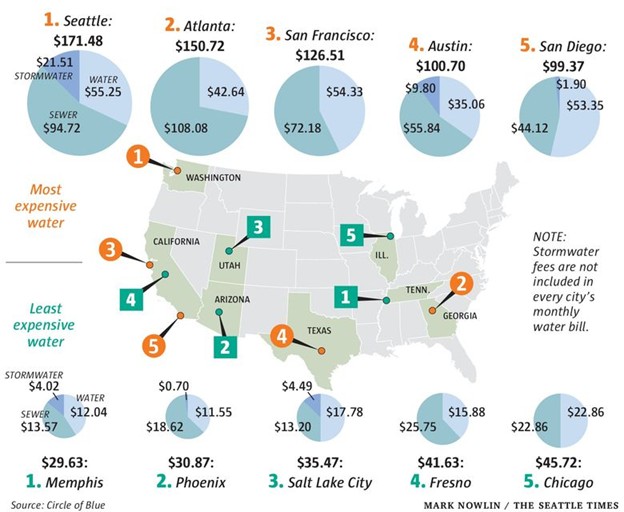
It is humbling to see that our great city, with its reputation for the rainiest weather, has the highest water rates in the nation, outpacing even the desert Southwest. It is a complicated story, as the water component makes up only one-third of the total water bill because sewer and stormwater management are included, but the water portion alone is still one of the most expensive by itself. There are also many water districts, all with differing rates. However, water conservation is a key component of property landscape management, and we focus on it because we feel we have developed great skills and programs to serve our clients.
July is Smart Irrigation Month , which we celebrate each year by educating our customers about the water conservation services we provide and promote. As we begin the budgeting process for our clients' coming year, water conservation projects are at the top of the list as they have a great ROI.
Remote Irrigation Control

Our partnership with Weathermatic Irrigation has helped us manage water through their SmartLink Remote Controller. It slightly increases our monthly service cost, but when we considered the value to our customers and the improved efficiency in system programming and troubleshooting, we decided to add it to our standard maintenance program for most controllers that are not already on a remote-access or weather-based system.
Weather Based Irrigation Control
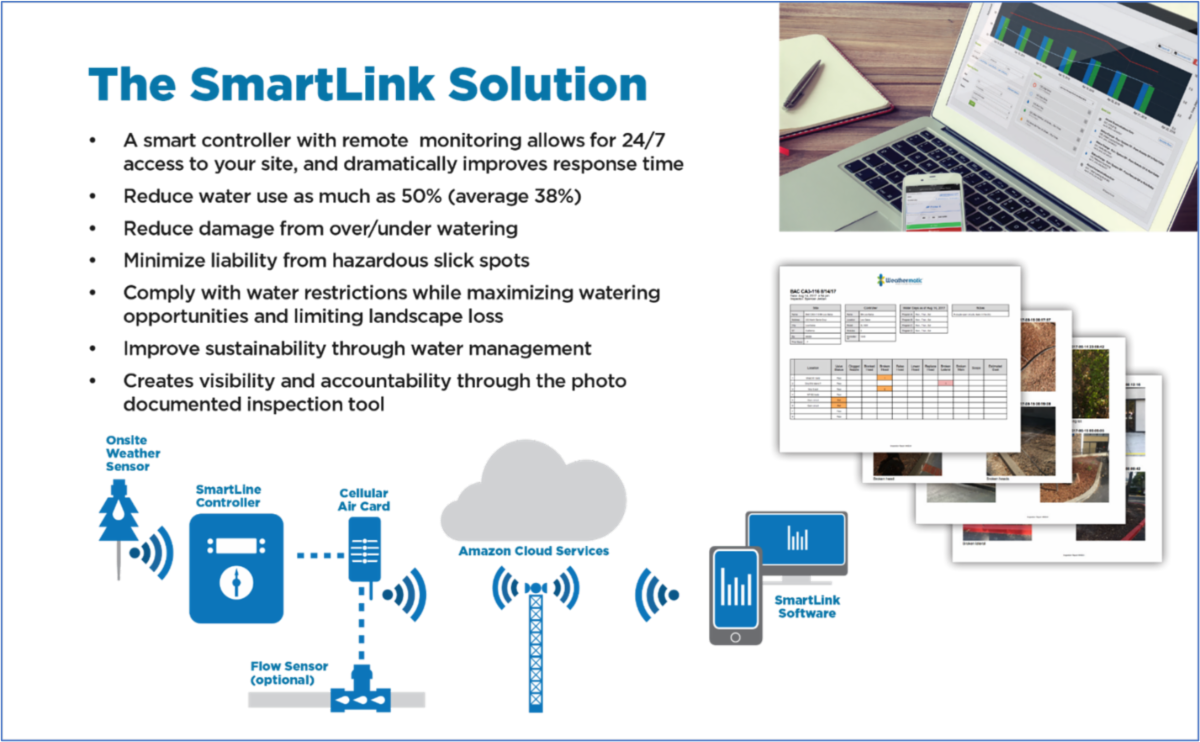
We have found through our experience with water conservation tools over the past decade that weather-based irrigation control saves 20 to 30 percent compared to traditional manually programmed systems, making it a no-brainer with water rates rising so rapidly. For a small additional fee with the subscription-based SmartLink Wireless Landscape Network Weather Base Irrigation Control, we can provide you with those savings, which more than cover the subscription cost.
Pressure Regulated Sprinklers
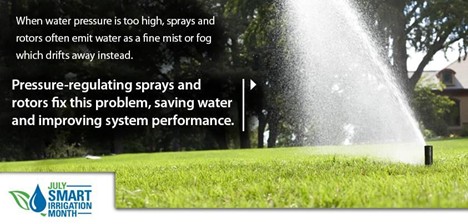
Historically, most irrigation systems have non-pressure-regulated sprinklers that often operate over-pressurized. Over-pressurization can lead to water losses and contribute to uneven watering.
Pressure-regulating spray heads are a developing technology designed to regulate pressure for optimal performance. These spray heads include built-in regulators that maintain a more constant pressure for better nozzle performance.
WHY IS PRESSURE REGULATION IMPORTANT?
Two reasons: it will save water, and it is likely soon to be required by law.
WATER SAVINGS:
Compared with non-regulated sprinklers, pressure-regulated sprinklers use about 20-25 percent less water . And if the nozzle breaks, pressure regulators are estimated to save up to 70% of the water that might otherwise have been wasted with an older sprinkler system.
PRESSURE REGULATED SPRINKLERS NOW REQUIRED BY LAW:
Washington and Oregon, along with California, Colorado, Hawaii, and Vermont, have adopted regulations banning the sale of non-pressure-regulated spray heads in recent years.
Lawn Conversion
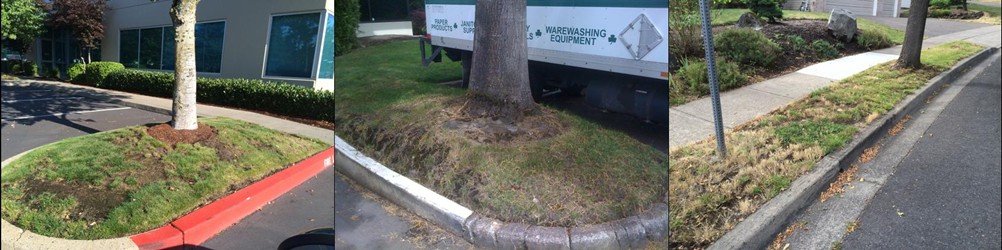
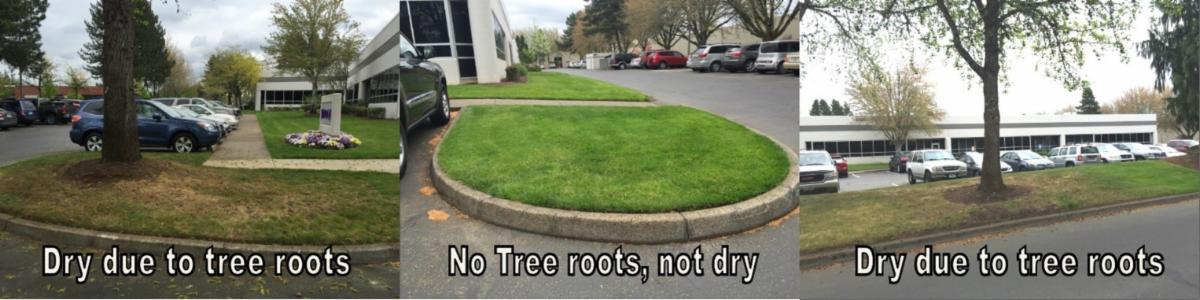
With the hot, dry weather this summer and every summer, we saw dry spots develop in lawns where it is difficult to water. In some of these areas, water conservation is best achieved by changing the landscape and giving up on lawn. Don't get us wrong, we love lawn. Quite frankly, we make our living managing and maintaining lawns. That being said, we also hate trying to maintain lawn where it won't grow or where it is hard or expensive to maintain. The pictures above are examples of where lawn should not be.
Why is lawn where it shouldn't be?
The simplest answer is that lawn is the cheapest part of landscape installation and, when brand new, looks great. New lawn on freshly prepared soil looks great. Parking strips and parking islands are probably the worst places for lawn. There is concrete or asphalt on most or all sides, and often the soil is shallow or there is rock or asphalt below. Irrigation coverage is difficult because of small, odd shapes, and as tree roots develop, they compete for moisture. We believe that parking strips and islands may take five to ten times more irrigation to maintain. This is a bad combination for growing and maintaining lawns. In addition, these areas are difficult and sometimes dangerous to maintain because of nearby cars and obstacles.
What is the alternative?
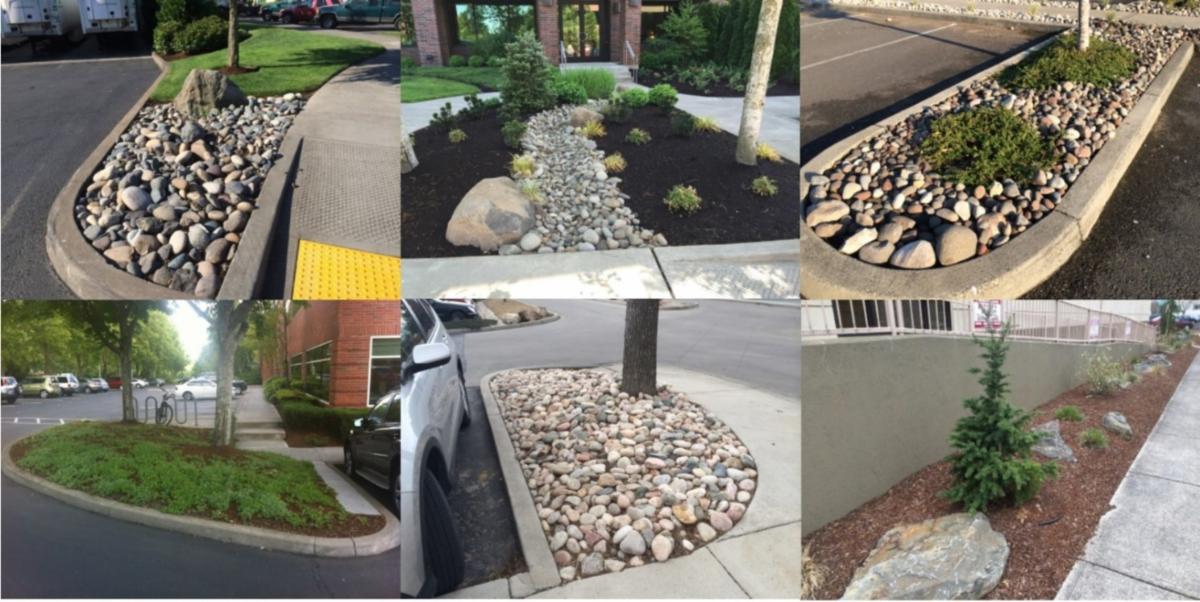
There are lots of options. Replacing lawn with bark dust or some type of groundcover are both options. We have experimented with sedum like on green roofs, but it has had only marginal success. We are seeing both locally and nationally the use of rock and are very excited about that as an option. Below are several pictures of rock as a groundcover that is very attractive and easy to maintain. Rocks do not need water and never die. Some people have expressed concern about the liability risk with rocks, but we believe that risk is low. If someone wants to throw a rock through a window, they will find one even if there is no rock in the landscape.
Weather-Based Control
Pressure Regulation
for Difficult Lawn Areas